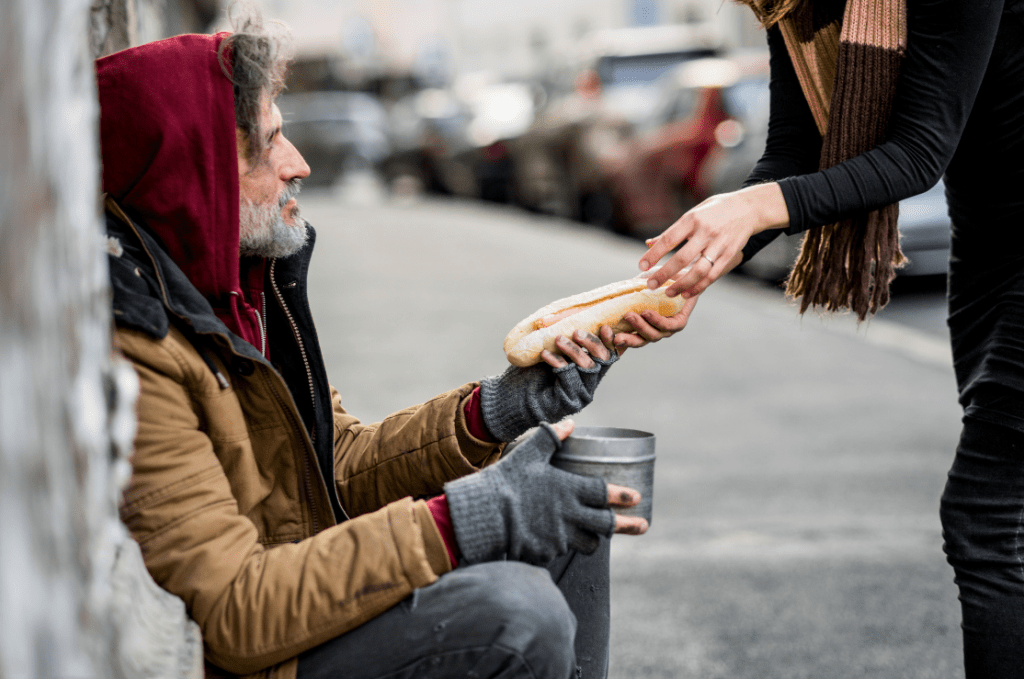
I live in a small town where homelessness isn’t always visible. But in the last month, I’ve noticed a homeless man who sits in various places around town. I first spotted him on a cold, rainy Saturday morning while driving to my pottery class. He was crossing an intersection I was turning onto, and I immediately saw that he was carrying all his belongings in plastic shopping bags. He also wore very old slip-on shoes (too small for his feet) with no socks. ‘How miserable,’ I thought. I could feel his discomfort and hoped he’d find some dry place to shelter. When class ended, I drove around to see if he was still in the area but couldn’t find him. I thought of him the rest of that day, hoping he was okay.
A few days later, I spotted him again. This time, he was across the street from the post office. It was a sunny day but frigid, and temperatures were to dip down into the 30s that night. He was sitting at a bus stop against a brick wall, facing the sun as if to absorb its heat. Again, I noted the bare feet in too-small slippers and shuddered, thinking of what he must be enduring.
I’d seen homeless people many times before in big cities like Chicago, St. Louis, and Washington, D.C.– always bothered by their circumstances. But perhaps because seeing a homeless person was so rare in my small town, this man was consuming my thoughts.
I began researching what social services were available in our community to help. And though there were a few options, there weren’t many. And there seemed to be some hoops to jump through to get quick assistance. I began contemplating introducing myself and taking him some food and socks. But I was afraid. What if he was violent or threatening? Then again, what if he wasn’t? What if my fear was holding me back? What if I could make a difference in his life, even if only for a day, an hour, or a few minutes?
I decided to venture into unknown territory and see where it would take me. I went to some stores and bought things to help keep him warm – socks, gloves, a scarf, and earmuffs. And I added some packages of things to eat, like nuts, dried fruit, and jerky. It wasn’t much –but maybe it could help. Then I went looking for him. And wouldn’t you know I couldn’t find him. Perhaps he’d moved on or found someplace to stay. That would be a blessing. But then, what if he hadn’t? What if he had frozen in the night?
When I returned home, I decided to call the police–not to lodge any complaint, but to inquire about available services and if he was on their radar. I was super impressed with our local police department. I spoke to their community services officer, who knew exactly who I was inquiring about and assured me she was speaking to him daily and had a place lined up for him to stay. The problem was he was refusing to stay in the lodging offered. He wasn’t sure it was for him, and he acted like he didn’t want to be a bother to anyone. This surprised me. How could he refuse a warm bed on such cold nights? Such a refusal could result in dying of exposure. No one would offer to help if they thought it was a bother. He had fears I couldn’t understand. The officer assured me she would keep trying to persuade him and, in the meantime, if I wanted to give him some food, he would probably accept it, and I shouldn’t be afraid.
The next night and day that followed were even colder, with temperatures down in the 20s. I was determined to introduce myself to him and take some gifts. I would ask him what he liked to eat and get it for him, whatever it would be. I drove to the corner by the post office. Not there. I went to the Presbyterian church bus stop. Not there. I drove by the YMCA, the train station, and the park just off the town square, looping back around the courthouse, library, and entire downtown area—no sign of him.
I was disappointed not to see him and give him the things I bought, but also hopeful that the officer I spoke with had persuaded him to accept shelter. Perhaps I’d see him again when warmer weather came through, but I didn’t see him for the next two weeks.
And then it happened. In a different place, I saw him curled up on a bench with his plastic bags of belongings scattered around his feet. So tomorrow morning is it!
I will find him, walk up to say hello, lay my gifts at his feet, and wish him peace and a beautiful day. It may not matter or do any good. But my heart says I have to try.
Since all this interest in homelessness began, I’ve learned that November is National Homeless Awareness Month coincidentally. And a few articles in our local newspapers have been most eye-opening. In a nearby town, a Park District Director reported at a City Council meeting that all 13 of the park’s outdoor restrooms are used by homeless people needing places to sleep. A few of those restrooms even had cots set up in them. She also reported that some people without housing were families with children and reported on the school district’s statistics for children facing homelessness.
Many homeless people don’t live on the street but out of their cars or do couch-surfing – going back and forth between the homes of family or friends that allow them to sleep on their sofas. Imagine what that kind of stress would be like for a child. The little boy or girl your child sits next to in class all day, eats with, and plays with might not be leaving school for a warm and inviting home with their own bed to sleep in. They may not know from day to day where they will sleep or eat. How unsettling and frightening for them, and no doubt such circumstances hamper their health and ability to learn at school.
Homelessness pulls at my heart because long ago, when my dad was only 19 years old, he was homeless, partly by choice and partly out of necessity. He’d left his parents’ house to make a life on his own, moving to Ohio to attend meat-cutting school. He lived on a small loan from his father. Once he completed school, he traveled around to different communities seeking work as a meat cutter.
Finally, he found a community he liked and wanted to stay in. The problem was the loan money was gone, and he had little to live on until he started receiving paychecks. He would live hand to mouth, from check to check, and try to pinch away as much income as possible to save for an apartment and future necessities. He lived out of his car as he attempted to build a little nest egg and repay his dad’s loan. He’d work all day, get off work and find something to eat, then wander, exploring things. He worked with a young man who lived at the YMCA, who let him shower there a few times each week. And when evening rolled around, Dad drove his car to the edge of town and slept in his car behind the city park. This arrangement worked for a while until winter was about to arrive.
Illinois winters can be brutal. Some of Dad’s co-workers, aware of his situation, began to worry about him, so did some investigating. They found an elderly woman who lived alone and would let Dad rent a bedroom cheaply. He agreed to it, and over the next year, she became his friend, often cooking for him and treating him like a son. The kindness and generosity of those caring people gave my father the break he needed to save some of his earnings and have safety and comfort. Within a year, he met the woman who would become my mother, and soon after that, they found a way to marry, buy a house, and welcome me into the world.
As the Thanksgiving holiday approaches, I urge everyone to take stock of all the blessings in their life and to consider ways you can give to others. Express your gratitude to those who care and share. Then, pass it on.
Postscript:
Today was the day! I delivered a backpack filled with helpful items (a scarf, mittens, hat, socks, healthy snacks, and personal hygiene items), coffee, and a McDonald’s lunch. As I approached the gentleman, he sat very still and wary, watching me, and did not answer when I said, “Good Morning.” I sat the backpack, coffee, and lunch beside him and said, “These are for you.” He smiled very slightly and, in a faint voice, said something like “Oh” or “thank you.” It was not clear to me. I decided not to press him for his name or any conversation because I didn’t want him to feel he owed me anything or make his privacy feel threatened. So, I turned and said, “You have a good day.” Then, I walked back to my car and drove away.
I don’t know how he felt about it all, but I know my heart feels better for acknowledging him.
For this month’s Recommended Read, I’ve reviewed The Old Man, a picture book by Sarah V., illustrated by Claude DuBois.
And under Activities, you can learn how to Make A Gratitude Tree with your Thanksgiving guests.
 Little Seeds Read