It’s That Time Again

It’s hard to believe we are smack in the middle of December already. Where does the time go? One event that many kidlit authors look forward to this month is author Susanna Leonard Hill’s annual Holiday Writing Contest. What makes Hill’s contest so much fun, and challenging is that each year we are given a prompt to develop our stories around and our word limit cannot exceed 250. Those of you out there who think writing children’s books is easy, don’t know the half of it. There are many rules to follow in developing books for young readers and conveying an entertaining tale in a handful of words that show more than tell can be exceedingly difficult.

This year’s contest theme is countdowns. Contest participants are to write a holiday story in 250 words or less with some sort of a countdown, central to the story. And there have been so many creative takes on this challenge. If you’d like to read the entries or join in the fun you can check out the entries on Hill’s blog: https://susannahill.com/blog/

I’ve thrown my hat in the ring and am sharing my story here. It was inspired by my memories of life with a very special cat named Ernie, many long Christmases ago.

Happy Holidays everyone!

Mittens’ First Christmas

There once was a little black furball with snow-white paws.

Mittens was her name, and mischief was her game.

December had arrived and Mittens hid, watching as her family prepared for Christmas.

Ben hung one sprig of mistletoe in the hallway.

Mom polished two golden angels in the dining room.

Maya added three wisemen to the manager.

The mailman delivered four festive cards.

Tonya tied five beautiful bows to packages.

Grandma baked six sugar cookies for Santa’s plate.

Sylvie taped seven shimmery stars to the refrigerator.

Amos arranged eight candy canes in a jar.

Dad draped nine greenery garlands over the windows.

And Grandpa tossed ten rows of tinsel onto the tree.

For weeks Mittens carefully tiptoed and sniffed around the decorations and considered climbing the twinkling tree.

At last, Christmas Eve arrived. Everyone placed gifts beneath the tree, including one for Mittens.

While everyone slept, Mittens’ nose began to twitch. Her package smelled divine!

She frenziedly ripped into the package. Aha– a tiny felt mouse!

Mittens pummeled, licked, and chomped it until suddenly, the room whirled, her eyes swirled and

BA-ZZING…  Mittens went WILD!

Later, everyone awoke to open their gifts. Imagine their surprise finding:

Ten trails of tinsel

Nine lopsided garlands

Eight crushed candy canes        

Seven scattered stars  

Six crumbled cookies 

Five unraveled bows

Four crinkled cards

Three missing wisemen

Two fallen angels

One mangled mistletoe

And Mittens in the Christmas tree!

That was the year Mittens’ family learned you should never give kittens catnip for Christmas.

Practicing Grace

I live in a small town where homelessness isn’t always visible. But in the last month, I’ve noticed a homeless man who sits in various places around town. I first spotted him on a cold, rainy Saturday morning while driving to my pottery class. He was crossing an intersection I was turning onto, and I immediately saw that he was carrying all his belongings in plastic shopping bags. He also wore very old slip-on shoes (too small for his feet) with no socks. ‘How miserable,’ I thought. I could feel his discomfort and hoped he’d find some dry place to shelter.   When class ended, I drove around to see if he was still in the area but couldn’t find him. I thought of him the rest of that day, hoping he was okay.  

A few days later, I spotted him again. This time, he was across the street from the post office. It was a sunny day but frigid, and temperatures were to dip down into the 30s that night. He was sitting at a bus stop against a brick wall, facing the sun as if to absorb its heat. Again, I noted the bare feet in too-small slippers and shuddered, thinking of what he must be enduring.

I’d seen homeless people many times before in big cities like Chicago, St. Louis, and Washington, D.C.– always bothered by their circumstances. But perhaps because seeing a homeless person was so rare in my small town, this man was consuming my thoughts.

I began researching what social services were available in our community to help. And though there were a few options, there weren’t many. And there seemed to be some hoops to jump through to get quick assistance. I began contemplating introducing myself and taking him some food and socks. But I was afraid. What if he was violent or threatening? Then again, what if he wasn’t? What if my fear was holding me back? What if I could make a difference in his life, even if only for a day, an hour, or a few minutes?

I decided to venture into unknown territory and see where it would take me. I went to some stores and bought things to help keep him warm – socks, gloves, a scarf, and earmuffs. And I added some packages of things to eat, like nuts, dried fruit, and jerky. It wasn’t much –but maybe it could help. Then I went looking for him. And wouldn’t you know I couldn’t find him. Perhaps he’d moved on or found someplace to stay. That would be a blessing. But then, what if he hadn’t? What if he had frozen in the night?

When I returned home, I decided to call the police–not to lodge any complaint, but to inquire about available services and if he was on their radar. I was super impressed with our local police department. I spoke to their community services officer, who knew exactly who I was inquiring about and assured me she was speaking to him daily and had a place lined up for him to stay. The problem was he was refusing to stay in the lodging offered. He wasn’t sure it was for him, and he acted like he didn’t want to be a bother to anyone. This surprised me. How could he refuse a warm bed on such cold nights? Such a refusal could result in dying of exposure. No one would offer to help if they thought it was a bother. He had fears I couldn’t understand. The officer assured me she would keep trying to persuade him and, in the meantime, if I wanted to give him some food, he would probably accept it, and I shouldn’t be afraid.

The next night and day that followed were even colder, with temperatures down in the 20s. I was determined to introduce myself to him and take some gifts. I would ask him what he liked to eat and get it for him, whatever it would be. I drove to the corner by the post office. Not there. I went to the Presbyterian church bus stop. Not there. I drove by the YMCA, the train station, and the park just off the town square, looping back around the courthouse, library, and entire downtown area—no sign of him.

I was disappointed not to see him and give him the things I bought, but also hopeful that the officer I spoke with had persuaded him to accept shelter. Perhaps I’d see him again when warmer weather came through, but I didn’t see him for the next two weeks.

And then it happened. In a different place, I saw him curled up on a bench with his plastic bags of belongings scattered around his feet. So tomorrow morning is it!

I will find him, walk up to say hello, lay my gifts at his feet, and wish him peace and a beautiful day. It may not matter or do any good. But my heart says I have to try. 

Since all this interest in homelessness began, I’ve learned that November is National Homeless Awareness Month coincidentally. And a few articles in our local newspapers have been most eye-opening. In a nearby town, a Park District Director reported at a City Council meeting that all 13 of the park’s outdoor restrooms are used by homeless people needing places to sleep. A few of those restrooms even had cots set up in them. She also reported that some people without housing were families with children and reported on the school district’s statistics for children facing homelessness.

Many homeless people don’t live on the street but out of their cars or do couch-surfing – going back and forth between the homes of family or friends that allow them to sleep on their sofas. Imagine what that kind of stress would be like for a child. The little boy or girl your child sits next to in class all day, eats with, and plays with might not be leaving school for a warm and inviting home with their own bed to sleep in. They may not know from day to day where they will sleep or eat. How unsettling and frightening for them, and no doubt such circumstances hamper their health and ability to learn at school.

Homelessness pulls at my heart because long ago, when my dad was only 19 years old, he was homeless, partly by choice and partly out of necessity. He’d left his parents’ house to make a life on his own, moving to Ohio to attend meat-cutting school. He lived on a small loan from his father. Once he completed school, he traveled around to different communities seeking work as a meat cutter.

Finally, he found a community he liked and wanted to stay in. The problem was the loan money was gone, and he had little to live on until he started receiving paychecks. He would live hand to mouth, from check to check, and try to pinch away as much income as possible to save for an apartment and future necessities. He lived out of his car as he attempted to build a little nest egg and repay his dad’s loan. He’d work all day, get off work and find something to eat, then wander, exploring things. He worked with a young man who lived at the YMCA, who let him shower there a few times each week. And when evening rolled around, Dad drove his car to the edge of town and slept in his car behind the city park. This arrangement worked for a while until winter was about to arrive.

Illinois winters can be brutal. Some of Dad’s co-workers, aware of his situation, began to worry about him, so did some investigating. They found an elderly woman who lived alone and would let Dad rent a bedroom cheaply. He agreed to it, and over the next year, she became his friend, often cooking for him and treating him like a son. The kindness and generosity of those caring people gave my father the break he needed to save some of his earnings and have safety and comfort. Within a year, he met the woman who would become my mother, and soon after that, they found a way to marry, buy a house, and welcome me into the world.

As the Thanksgiving holiday approaches, I urge everyone to take stock of all the blessings in their life and to consider ways you can give to others. Express your gratitude to those who care and share. Then, pass it on.

Postscript:

Today was the day! I delivered a backpack filled with helpful items (a scarf, mittens, hat, socks, healthy snacks, and personal hygiene items), coffee, and a McDonald’s lunch. As I approached the gentleman, he sat very still and wary, watching me, and did not answer when I said, “Good Morning.” I sat the backpack, coffee, and lunch beside him and said, “These are for you.” He smiled very slightly and, in a faint voice, said something like “Oh” or “thank you.” It was not clear to me. I decided not to press him for his name or any conversation because I didn’t want him to feel he owed me anything or make his privacy feel threatened. So, I turned and said, “You have a good day.” Then, I walked back to my car and drove away.

I don’t know how he felt about it all, but I know my heart feels better for acknowledging him.

For this month’s Recommended Read, I’ve reviewed The Old Man, a picture book by Sarah V., illustrated by Claude DuBois.

And under Activities, you can learn how to Make A Gratitude Tree with your Thanksgiving guests.

Hooray for Halloween!

Copy of Watercolor Autumn Leaves A4 Stationery Page Border – 3

I don’t know what it is about being an adult and enjoying the holidays and seasons more. Perhaps it’s because as you grow older, the faster the years seem to go, and the sweeter the memories of the past become. For instance, I know I am not the only adult who enjoys Halloween. When I was a kid, the adults never dressed up for the celebration, but today, there are so many adult costumes and adult Halloween parties. The same is true for decorating the house for Halloween. My neighbors across the street have been decorating for Halloween for almost a month. Every time I look out the window, I see something new added to their home and lawn. And at night, their lit-up house is the only one on the block announcing, “It’s coming! Can you feel it in the air?”

I decorate for the season, too, though my home has no witches or giant spiders looming from the shutters. I put out mums and pumpkins, and male and female scarecrows flank either side of my front porch. Inside, there are pumpkins and fall décor in all the downstairs rooms. And yes, like so many others, I’m into pumpkin-scented candles and pumpkin-flavored everything. My pumpkin spice coffee with pumpkin spice creamer gives me the perfect jumpstart I need each morning. 

Nowadays, I enjoy looking at all the Halloween items in stores as much as I do the Christmas things. The only thing I don’t enjoy about this season is that I now pay $15 for a bag of treats to give the trick-or-treaters. I’ll have to buy two big bags and one small before it’s all said and done, as we get bombarded by little tricksters on the big night. We are sometimes the only neighbors to have our lights on for trick-or-treaters. Perhaps it’s the cost of the candy that keeps others from participating. It’s also possible that because our neighborhood is predominantly made up of senior citizens, they feel overwhelmed or even anxious about all the strangers that can show up and pound on the door and peer in windows expectantly. For now, though, I enjoy it.

For years, my husband and I lived in the country and never had a single child visit our home on Halloween night, though there were children who lived just a bit down the road. Country children drive to towns for Halloween fun and enjoy activities at churches, YMCAs, schools, or “trunk or treat” events in parking lots. But when Tom and I moved to a town three years ago, we got a big surprise. Halloween was observed over two nights, and there was banging on the door for the first time in our lives. We had just a little over 200 trick-or-treaters in two nights. Some were small and couldn’t speak sentences yet, while others were teenagers, not even wearing costumes but trying hard to hang on to be their childhood selves. 

I knew they would come. I hoped they would come. Though I adore my beautiful grandchildren, I don’t get to see them as often as I like, and I need to have children in my life. I delight in watching kids grow and feel very alive around them.

When our first trick-or-treaters arrived, I would jump up and speed to the door to welcome them and let them pick through the treat bowl.   As more and more children came knocking, my husband couldn’t believe it, and he started answering the door, too. It turns out that this big ol’ guy who pretends not to care about such nonsense does enjoy it and likes being the one to hand out treats.

 I may have white hair and move slightly slower, but my heart is still young, and I enjoy playing. So, I am ready for the little darlings and can hardly wait to see what they wear and pretend to be this year. Maybe I will wear a costume too this year and surprise them when I answer the door!

For this month’s Recommended Reads, I’ve reviewed an old favorite of mine, The Bake Shop Ghost by Jacqueline Ogden – a super sweet ghost story just in time for Halloween.

And under the Activities section of this blog, be sure to check out my instructions for making a beautiful Fall Leaf Luminary.


Thinking Outside and Inside the Box

As summer draws to a close, I can’t help but remember long-ago summer days of discovery and play during my childhood. One of the things that made summers so special was how my Dad always invented things to keep us kids from driving Mom crazy. Three children under ten were undoubtedly a handful for her, with our petty squabbles and toys spread all over the house. Consequently, we were always encouraged to play outdoors whenever possible, which didn’t bother us. The outdoors was where we could be wild.

One time, Dad got the idea to build us a tower of giant stacked wooden spools from the power company. We would climb on them. And a few had little openings cut into the centers so we could crawl inside and hide. We loved our “spool house,” but it couldn’t handle the weight of three kids climbing all over it and all the other neighborhood kids who were drawn to it. So, Dad had to take it down. Then, he came up with a far simpler idea to entertain us. He brought three large cardboard refrigerator boxes for us to do whatever we wished.

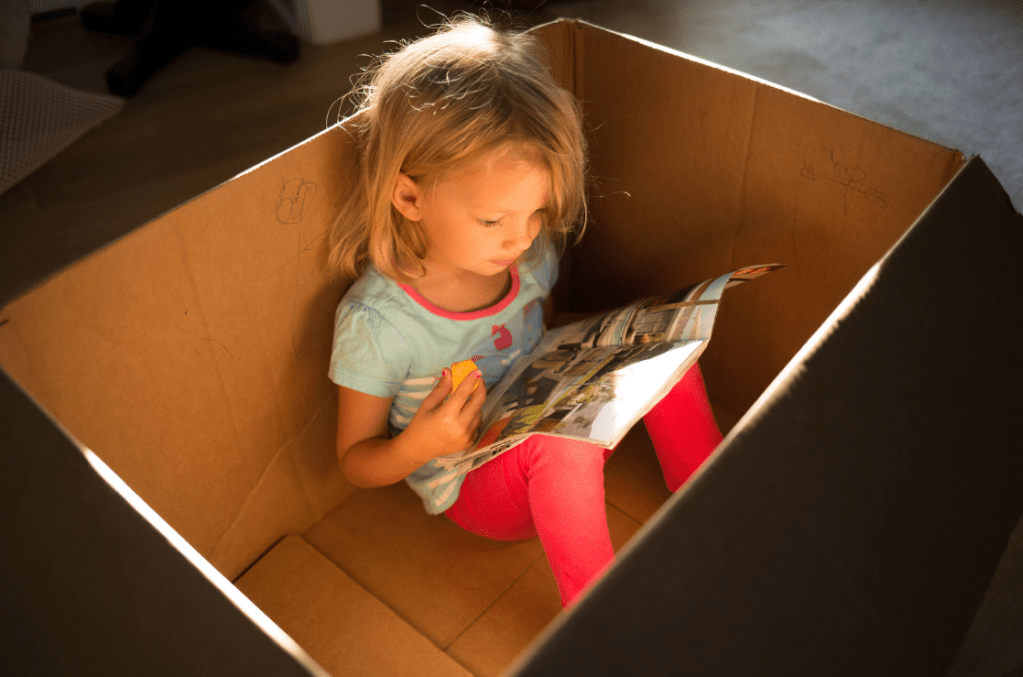
We were ecstatic! We collected scissors and tape and dragged the boxes to the back patio, where we quickly began designing our “box houses.” What fun we had defining our little hide-away spaces. We cut windows in the sides to peek at one another and let the breeze flow through. And, of course, we decorated the exteriors with our crayons. If one of us felt grumpy, we could retreat inside our box house and close the flaps, yelling “Keep Out” if we wanted to be alone. But often, we left our doors open and visited each other’s “home.”  I remember that I loved lying inside my box and reading a book or singing to myself. I felt such a peace inside the box.

When interest in our box houses waned, we found other uses. There was a large hill at the back of our property, and we used the flattened boxes to slide down the grassy hill – a way to go sledding in summer! One of my brothers had the bright idea to take a box, open both ends and, crawl inside, then thrust himself into the side, causing the container to tumble down the hill with him in it. The more this was done, the more the boxes broke down and began to lose their corners until they became shaped like giant toilet paper rolls. I wasn’t keen on this particular game, as it made me feel sick and dizzy. But apparently, some kids like that.

Though I now live in a big house with plenty of room, I still sometimes crave a quiet, secret get-away space – a place where I could go to create, dream, and nap – something like a studio space. For now, the basement has become my studio, and while that space serves my needs, I miss the sunlight and wish I had a flap to lift so I could look out on the world or allow bird and cricket songs to reach me.

Before we moved to our current home, I had these same longings and decided to do something about it. I built a “she shed” from found lumber, pallets, discarded windows, and sheets of tin. The result was a structure that would never pass any building code but nevertheless had an abundance of charm, light, and energy that inspired me. And I did manage to do a small amount of creating there, daydreaming, and even a few siestas. I don’t know if it’s true for all people, but in my experience, having a tiny place to call your own, where you can hide and make room for growing big ideas, is something that began in me when I was small and still a part of who I am. Perhaps it all started with that first box gifted to me by my Dad.

For this month’s Recommended Read, you can read about Jane Yolen’s picture book, What To Do with a Box. There, I have also provided links to websites with some genuinely awesome ideas for making things from boxes.

Bygone Butterflies

In the 1960s, one of my favorite summertime activities was catching and observing insects. I had a little net and a “bug jar” that I’d place insects in for study. My bug jars were usually mason jars with nail holes hammered into the lids to create air holes for whatever I caught. I’d prepare the jar for its visitors by adding some sticks, grass, or leaves so the insects I caught could crawl on something. 

Since I was terrified of bees and wasps, they were never on my capture list. I mainly focused on moths, butterflies, fireflies, beetles, ants, and spiders. I loved watching them up close and studying the details of their curious bodies and behaviors until it was time to release them.

Of all the insects I caught, butterflies were the most enjoyable and challenging to catch. Butterflies just have a sense of when something is approaching too near, and they take off in zig-zaggy flight, making for an exciting chase. It’s only when they find an irresistible spot of nectar that they can’t ignore that you can actually have a chance at capturing them. If not, you might have more luck catching injured ones with damaged wings or missing legs. 

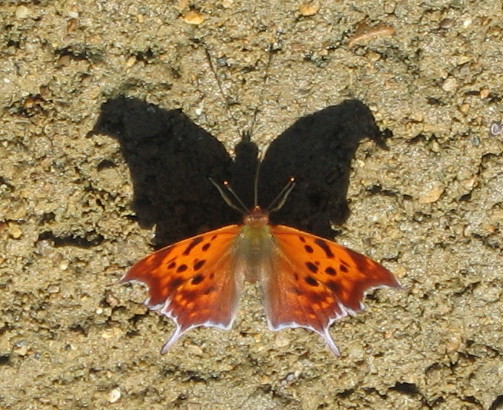
My parents were gardeners, so there was plenty in our yard to draw insects. I remember butterflies could easily be found. Swallowtails, Buckeyes, Sulfurs, Commas, Question Marks, and Monarchs were always plentiful and enjoyable. But alas, we took for granted that it would always be so.  

Fast forward to 2023. Despite my efforts to garden this summer, I’ve seen very few butterflies. Monarch butterflies, in particular, are very scarce. Every year I see fewer and fewer. It’s a great sadness for me, and I fear they’ll disappear altogether within my lifetime. How can this be? How can we, as supposed intelligent beings, let this happen? According to the National Wildlife Federation, Monarch butterfly populations have declined by 90% since the 1990s! We know why they are disappearing, and yet… we let it happen by destroying and marginalizing their habitat, applying herbicides and pesticides, then trying to justify our actions. There must be a better way.

Before moving to town, my husband Tom and I lived on a few acres in the Illinois River Valley. Tom had planted about a third of our property in prairie; butterfly life was abundant there. In our prairie, the butterflies were quite concentrated and diverse in species. While wanting to provide habitats for all butterflies, Tom aimed to develop an environment that would also draw the Regal Fritillary, a state-threatened species. Our prairie grew for 20 years, and every year, Tom monitored the butterfly population for the Regal Fritillary. It wasn’t until our last year living on that property that one finally appeared, so in moving and leaving our prairie, this accomplishment was bittersweet. The wonderful thing we’d long awaited had finally happened, and then it was time to go. Three years have passed, and I think about our butterfly friends and the new property owners. Is there still a safe haven there? Does the Regal Fritillary still appear? And for how long?

So, here we are again, in new surroundings, longing for butterflies. What can we do? Start over. We can consider how we personally impact the nature around us by making smart choices. We can forgo the perfectly manicured lawn and let the dandelions grow. We can avoid using herbicides and pesticides. We can plant more flowers. And we can spend as much time as possible savoring the outdoor world — watching for wildlife — for what shows up today could well be gone tomorrow.

To learn more about monarch butterflies, check out the National Wildlife Federations web page at Monarch Butterfly | National Wildlife Federation (nwf.org)

This month, under the Activities section, you can learn how to make a “Pollinator Puddler” offering refreshment to insects in your backyard. And under Recommended Reads, learn about the importance of puddles in Hello Puddle by Anita Sanchez and Luisa Uribe.

Neighborly Ways

I was fortunate to grow up in a neighborhood of loving and caring people. Daily interactions with them were the norm, and each of our neighbors felt like an extension of my family. For as long as I can remember, there was never a creepy or shifty individual on the street.

One of the reasons for our daily interactions was that several households had children, all within the same age range. We often walked together to and from school. My brothers and other neighbor boys played on the same baseball teams. We all shared the same sidewalks for riding our bikes. And my family’s house sat on two large lots that kids viewed as a public park where they could gather for play.

A comforting thing about my neighborhood was that the mothers always looked out their windows, monitoring their children’s whereabouts and behavior. All our mothers were friendly with one another and took turns watching after us. Having a block full of mothers also meant you didn’t act up. If you did something naughty, someone would catch you. Though that could sometimes be a pain, it also made you feel safe.

Adults in our neighborhood were generally close. Folks sat outside on porches or visited in the street. Someone was always near to help if you needed a ladder, a cup of sugar, or an extra pair of hands to help with a task. There seemed to be this unspoken code: living in that neighborhood meant a commitment to be friendly, live in sync, and love thy neighbor. Though people did move in and out or die over the years, incoming families all tended to adopt the same attitude. As my parents aged and became more housebound, neighbors who had been around for decades helped look after them – shoveling their walks when it snowed, sharing plates of food, mowing, and checking for activity and safety.

My neighborhood now is also friendly but different from my childhood neighborhood. People are generally more withdrawn but sometimes look up and nod at one another. Two neighbors will walk up to the property line and visit briefly with us, and one time another neighbor came to the door to offer us some surplus sweet corn they’d grown.

A few weeks ago, a “derecho” with hurricane-like winds greatly damaged our community. On my street, the winds snapped a powerline in half, causing a giant fireball, then an electrical outage to 10 of the 13 residences here. Tree limbs flew everywhere, and it seemed as though the storm would never pass. But when it did, I looked out the window and saw all the neighbors gathering in the street to check on one another and survey the damage. It was a very moving sight. People cared about one another, even if they didn’t interact frequently. People seem to have become friendlier over the last few weeks, still talking about the storm a bit. 

Sometimes it doesn’t take much to form friendships. Small gestures can mean so much. When I was a girl, there was a widow – Mrs. Van Tuyle, who lived a few doors down. She was quiet and kept to herself, but she chatted with my mother occasionally. I remember playing on the sidewalk before Mrs. Van Tuyl’s house on a sweltering summer day. To my surprise, she opened her front door and said, “It’s awfully hot out. Would you like to join me for some lemonade and cookies?” I was stunned. She wasn’t a stranger, and yet, I didn’t really know her. I said, “Sure,” because I knew it would be okay with my mom. Mrs. Van Tuyl led me to her patio, where we enjoyed visiting over lemon sugar cookies and cold glasses of lemonade. She was a lovely woman, and I couldn’t understand why she would reach out to me at the time. When I finished my drink, I thanked her and said I’d better go, and she told me to tell the other kids I played with it was okay for them to stop by too. Later when I told my mom about what happened and asked why Mrs. Van Tuyl would do that, Mom said, “She’s lonely.” I was shocked because, at that point in my life, it never occurred to me that adults could get lonely. 

After that day, I always made a point to wave to Mrs. Van Tuyl. A few times, I even left her a May Day basket. And when I was around 12 years old, she and Mrs. Sonderager, another elderly widow in our neighborhood, started asking me to run to the nearby grocery store to pick up some items for them. Running these errands for them was my first paid employment. In high school, I began to think of my forthcoming independence and started a “hope chest” of things for my future home. I decided I needed to collect some recipes to learn to cook, and I knocked on Mrs. Van Tuyl’s door to ask if I could have her recipe for her Lemon Sugar Cookies because someday, I would be grown up with my kids, and I wanted to make them. She became teary and said, “Oh, aren’t you sweet,” and invited me inside while she jotted the recipe down. 

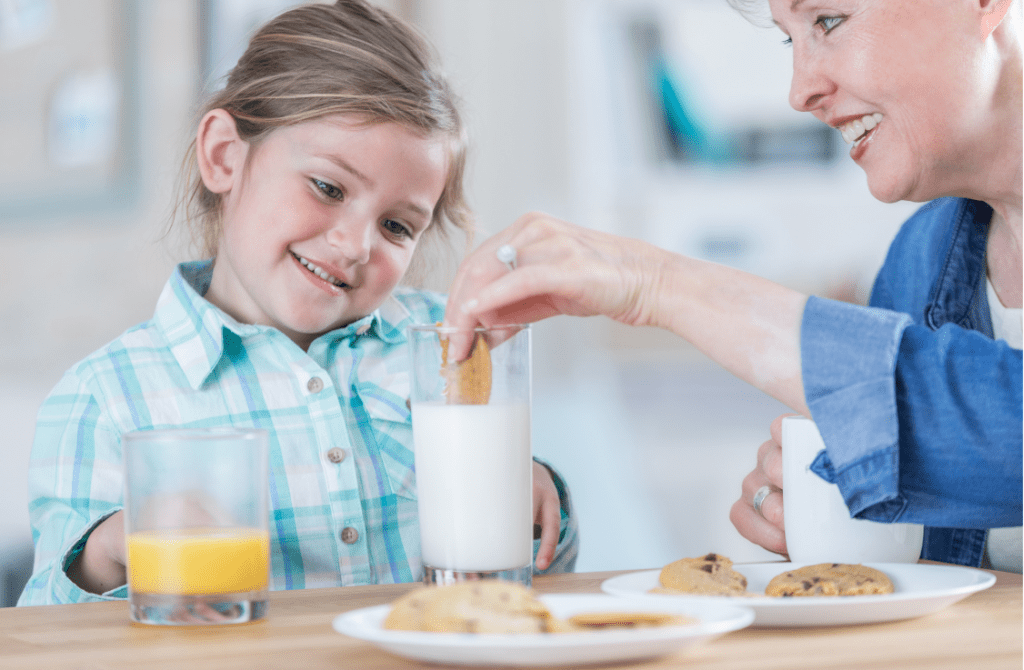
Mrs. Van Tuyl is now long gone, but after 50+ years, I still have her cookie recipe. It’s always been a favorite, as is the memory of sharing ice-cold lemonade and sugar cookies with a lonely neighbor. You can find Mrs. Van Tuyl’s Love-Thy-Neighbor Lemon Sugar Cookie Recipe in the Activities section of the blog. I recommend you serve them with lemonade and share with a neighbor, especially any neighbors you have yet to get to know. And under Recommended Reads, you can read my review of The Neighbors, written, and illustrated by Einat Tsarfati.

Chasing Wonder

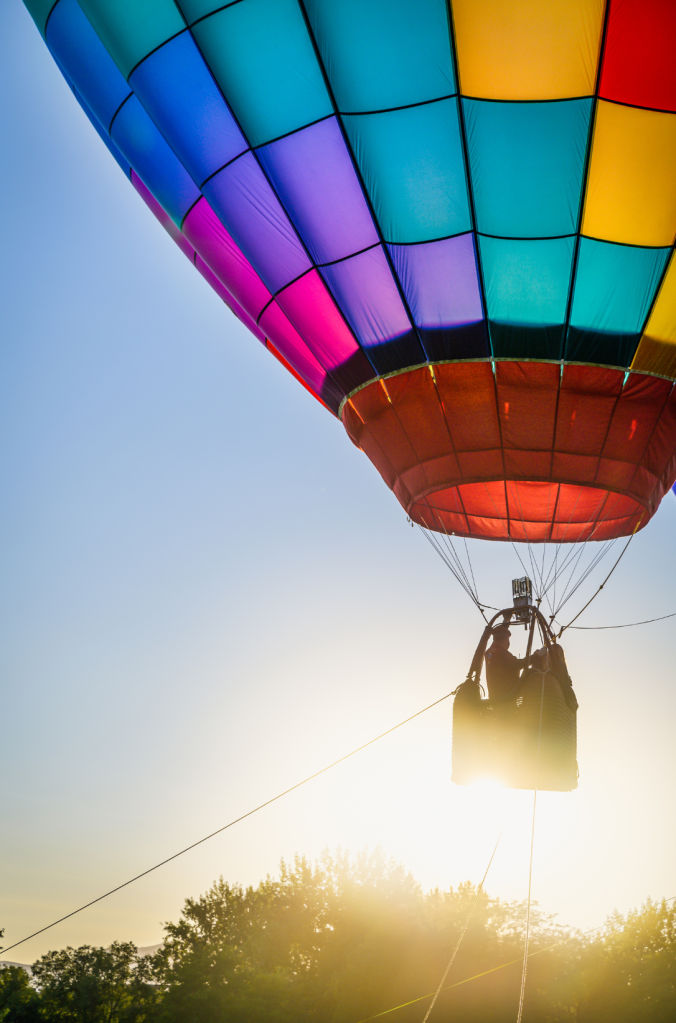
My husband and I did a big bucket-list thing a few weeks ago. We went on a hot-air balloon ride. Though we both had wanted to do this for many years, when it got to the day before the trip, I found I’d become a basket case of anxiety, googling on the computer to see how often people died in balloon crashes. I was at war with myself until we walked onto the launch field. Do it. Don’t do it. Take the risk and maybe die. Don’t take the risk and wonder for the rest of your life. As the crew inflated the balloon, we watched with the other passengers. An amiable and enthusiastic couple sat beside us. They’d made a 7-hour trip on a motorcycle from Nebraska to northern Illinois just for this experience. In the morning, they would turn around to head back home. Their smiles and excitement were contagious, and I soon felt my fears dissipate. I didn’t want to ruin this moment. I wanted to be more like them and embrace the adventure. And with the snap of a finger, I released my anxiety, in much the way our balloon lifted away from the ground to be carried by the wind. I’m so glad I let go of the worry and grateful for these optimistic souls traveling on the same path. The balloon ride was one of the loveliest experiences I’ve ever had. It was soothing and serene. Floating gently high above the ground offered incredible views of the rural scenery. I could imagine staying there forever, climbing higher, until maybe one-day finding heaven.

I am such a mixture of my mother’s and father’s personalities. Mom was a homebody with many fears and often tried hard to persuade people not to do things if it created anxiety for her. But Dad, on the other hand, was a risk-taker who always wanted to see and do more. How two such different personalities could be happily married for so long is anybody’s guess. But they were an excellent team, one balancing the other and keeping things in check. My Dad’s risk-taking and exploring ways are a big part of my early memories.

He taught us kids to swim, and ride bikes, took us sledding on giant, steep hills, built us forts and tree swings, bought us go-carts, took us to caves, and ensured we saw the ocean and mountains.

He encouraged us to get out into the world and discover its secrets. His own desires to chase wonders were significantly altered when he was diagnosed with Lupus in his late 40s. In the years that followed, not only did he deal with painful Lupus flair-ups and complications from having a weakened immune system, but he also became a hemophiliac and desperately needed a hip replacement but couldn’t have the surgery due to multiple health issues. His dreams of travel were dashed as he eventually became homebound. I think of my Dad whenever I feel wanderlust or want to do something risky. While I might hear my mother’s voice telling me all the dangerous things in the world, I also think of my Dad and how much more he’d longed to do and couldn’t. So, often, I take the risks he couldn’t and push myself through the anxiety to have new experiences. So far, I have never had any regrets.

If chasing wonder is something we are genetically predisposed to, my daughter and at least one of my granddaughters have inherited this trait. Recently, my granddaughter celebrated her 12th birthday, and her birthday wish was to don a wet suit, climb into a cage, and be immersed in a shark-filled aquarium. 

This would be too risky for me, but her parents felt she was with professionals and the circumstances were safe, so it happened. She assured me later that it was an entirely secure and highly controlled experience.

And I could tell from her account of the experience that it was something she’d never forget. 

So, here’s to you, Dad! Happy Father’s Day. Your love for adventure lives on in your family. Thank you for encouraging our curiosity. We miss you so much, and you’re with us in all that we do.

For a sweet book about chasing wonder to share with a child, check out Dan Yaccarino’s Doug Unplugged. You can learn more about it in the Recommended Reads section of my blog.

Mother’s Day Mementos

This Sunday, May 14th, is Mother’s Day, and I imagine that millions of little kids will be making something special for their mothers to show their love for them. As mothers, we get bombarded with art projects that are so precious we want to keep them all for eternity. Each has deep meaning for us and marks unique moments and insights into our child’s development. But alas, saving every keepsake for our lifetimes can become difficult.

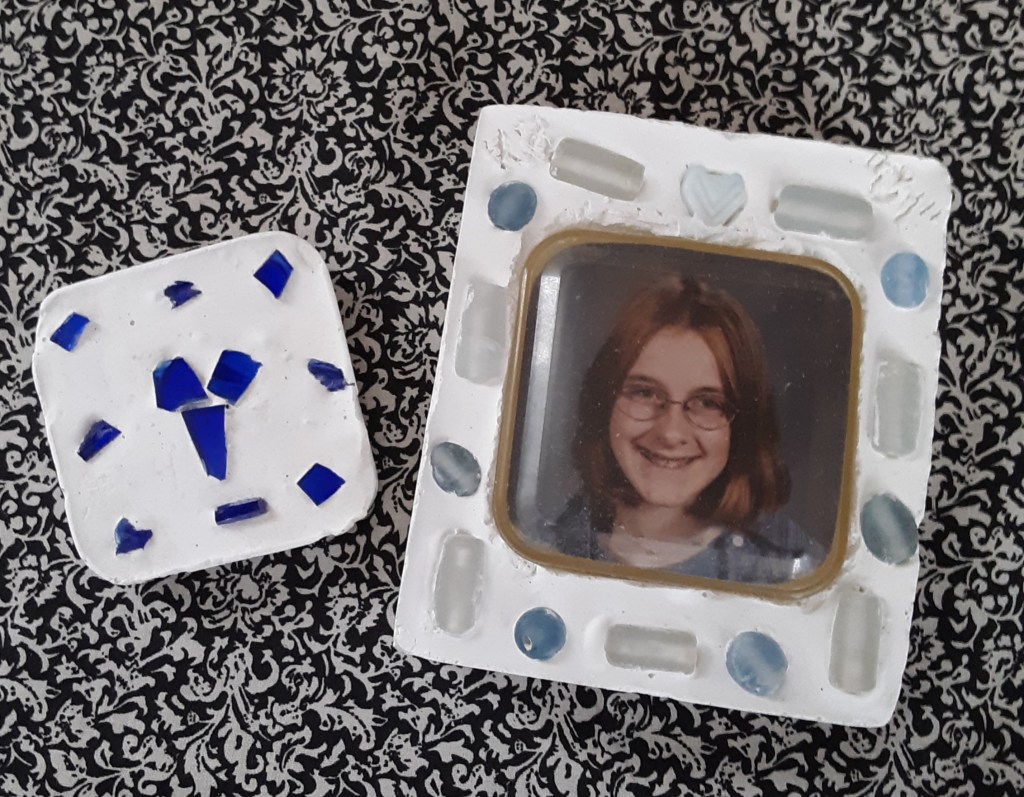
I’ve got a scrapbook of my favorite pieces of my daughter’s artwork and a few crafts that she made for me remaining where I can visit them. Two favorites are a paperweight and a picture frame she made with plaster, beads, and broken glass. She was about 11 when she made them, and she crafted them in secret in our basement using my art supplies, which she did ask permission to use. I was sternly instructed not to snoop or bother her, and she knew what she was doing. I was shocked when I later learned that she had gotten into the plaster. I suppose she had learned how to mix it by watching me use it. And most miraculously, she never left a mess for me to be concerned with! This was my first clue that she was a fearless artist with clear visions of what she would create and determined not to let things stand in her path. I still have those two gifts, and every time I look at them, I see that delightful little girl and marvel at the wonderful woman she’s become. She’s still determined, creative, fearless, and has a clear vision of what is possible.

Last year, after my mother passed away, I spent several months cleaning out her house and packing up her things. It was such a bittersweet passage—painful to put away her life forever, but so dear in being able to remember her in every space and item. One of the things I came across was a small gift for her that my brother David made in kindergarten. It was a clay sculpture of a seal. It was so primitive and clever – just a simple thick, snake-like lump of clay with a raised head, two eyes, and a crooked smile. The glazing was splotchy white and looked like the fur of a baby seal. This happy little fellow sat in the kitchen window above the sink for a very long time. I would dry dishes for Mom after supper and admire my brother’s handiwork. My mom liked changing the décor in our house each season and often put flowers and pretty little colored glass vases on this same windowsill. But always, the little clay seal would return to his place in the window again and again. And I know this is because she loved it so much. So, as I packed up her possessions, I made sure that the seal was returned to David. I hope he realizes what it meant to her. She cherished and protected it for 52 years.

This month’s book review is for Heart Print: How Not to Foozle Mom’s Gift by my friend, Carrie Sharkey Asner, illustrated by Monika Marzec. It’s about a child who wants to make something extraordinary for her mother. You can read about it under Recommended Reads.

And for a simple but heartwarming Mother’s Day craft, check out my Twine-wrapped Heart Bookmark under the Activities section.

Rock Your World

There’s a rock in my backyard, a big mysterious pinkish rock that has a story to tell. It came with the property. And I’m pretty positive that one of the previous homeowners picked it up and dragged it home with the feeling that they’d made an important discovery. They were likely intrigued or inspired by it and determined to know its story. I know this because that’s how it has been with me and my rock discoveries. This is how it goes with rock lovers.

My love for rocks began when I was a child when my family traveled west on vacation. I was overcome with a curiosity for rocks I saw in clear mountain streams or glistening along a path. I’d heard about the Colorado gold rush, and we were passing through Colorado on the way to my uncle’s home in Utah. I was sure I could find gold, too, if allowed. But instead, what I found was pyrite, also known as “fool’s gold,” which pleased me every bit as much as any gold could. Throughout that trip, I picked up all sorts of rocks in all sizes and squirreled them away beneath the front seats of our family’s car, to the point that my father began to complain that he could feel sizeable rocks beneath his driver’s seat. At one point, he reached under the seat, pulled out some rather large rocks I’d collected, and told me not to pick up any more enormous stones, for they would eventually weigh down the car. It was hard to stop, for I had discovered granite, quartz, mica, and more! And I’ve never stopped loving rocks. 

To this day, I still need to stop at rock shops on our travels. I recently dragged my husband to a rock and gem show on one of February’s last cold wintry days. It was a fabulous escape on a windy, grey day. We watched rockhounds crack open geodes and entered a little black tent to see rocks and minerals that glowed in the dark with neon colors. We examined petrified wood and pondered wondrous fossilized fish and insects.

Apparently, the gene for rock-loving has been passed on to my family. When Katie, my daughter, was small, I took her to a park for a hike in the woods. We only had an hour to explore before we needed to be elsewhere. I had looked forward to some time on a forest path, but instead, we spent 45 minutes in the freshly graveled parking lot, where she discovered a cache of crinoid stems – which we picked by the handfuls to take home. I also remember her spending her birthday money and allowance on coprolites and minerals at flea market rock and gem booths. My granddaughter, Jaycie, also loves rocks and has begun a small collection. Her stepfather, Reid, knows of a secret place along a creek filled with geodes, and he takes her and her mother to collect them occasionally. As a result, they have some rather spectacular specimens lined up along the steps of their porch and in the kitchen and laundry room windows of their home.

Children are naturally drawn to rocks. They love to climb them, build imaginary worlds with them, throw them at targets, and plunk them in the water. At the end of my block is a small park with a creek running through the center. The stream is lined with rocks to help control erosion. Every day, when a nearby school lets out, numerous children can be scattered up and down the stream, climbing the rocks, searching for treasures, and discovering Mother Nature’s rocky mysteries.

Rock collecting is also a fabulous hobby for families to enjoy together. The quest to find different rocks from different regions of the country makes for some exciting adventures and teaches us about the diversity of the landscape. In addition, learning about geological forces behind rock formations helps us understand Earth’s processes over time and view the miraculous results with enlightened eyes.

This month, I’ve reviewed What Can You Do with a Rock? by Pat Zietlow Miller, illustrated by Katie Kath. You can read more about it under Recommended Reads.

And for a rock-related craft activity, check out my rock collage pictures in the Activities section of my blog.

Life’s Happy Little Accidents

I grew up in the 1960s and 70s when the popular painter Bob Ross had a PBS television series. His clever witticisms are well known and have made a big comeback in recent years as younger generations discover the magic in his positive outlook on life. One of my favorite Ross expressions is “happy little accidents,” which he used in explaining that our mistakes are just opportunities for growth and discovery.

I’m not proud that I have “perfectionist” tendencies. On the contrary, I view this part of my make-up as a curse I have battled all my life, even in childhood. When others around me seemed to roll and laugh with the punches, I took perceived failures too much to heart. It has only been since my retirement that I take life a little less seriously and can laugh when things fall short of my expectations.

At this age, I’m glad, so many things didn’t go as I had initially planned, for if they had, I would’ve missed out on so much – large and small, that has become so special to me.

Many things have occurred unintended in my life – broken relationships, job failures, parenting mistakes, and the consequences of being a stubborn hard-head. But despite it all, I’m okay with it and not unsatisfied with who I am now. Of course, I could be better and will continue to aspire. But I am no longer devastated when things don’t turn out as I wish.

I’m reminded of a day when a close friend and I drove to another town for shopping and dining. One of us thought we knew a shortcut through the country and promptly became lost. My friend was upbeat and confident the road would eventually lead to where we wanted to go. But I was impatient and anxious, partly because I had a full bladder and somewhat because my gas tank was nearly empty. I grew increasingly agitated, but suddenly, we came around a curve by a horse farm. And for as far as I could see, old worn cowboy boots had been turned upside down and placed on top of all the fence posts. It was unique, personal, and charming. Someone had been raising horses and farming for a very long time. The boots may have been placed on the posts’ tops to help slow their eroding from rain, snow, and ice. But the boots also personalized the landscape and told the landowner’s story. We loved it; the image has stuck with me for several years. Being lost led to a cool sight.

Another “happy accident” I had was learning to make homemade mayonnaise. I was in a hurry and foolishly trying to prepare the recipe without wearing my reading glasses. When I meant to grab the clear bottle of white vinegar, I grabbed the clear bottle of almond extract that sat next to it and did not read the labels. My mayonnaise concoction looked beautiful, but something was terribly wrong when I spread it on the sandwich. It didn’t smell at all like mayonnaise. It was almond-flavored mayonnaise that was a disagreeable disaster. My husband has never let me forget it. And though I was embarrassed and disappointed in myself then, we have since enjoyed many good laughs over the incident. That failure led to some happy laughter, which I consider a sweet blessing.

When my granddaughter, Jaycie, was 3 or 4, I remember her trying to draw something and becoming upset because she couldn’t make the image she had in her head. She pouted and threw her pencil. I told her not to be hard on herself and that mistakes could be made interesting. To demonstrate, I took some scrap paper and had her make squiggly “mistakes” on it. Then I turned the paper this way and that and added my own lines to turn her squiggles into silly creatures. Her smile filled my heart, and I’d made my point. I then took a turn to make a squiggle and passed the paper back to her, and she put her spin on it. We went back and forth like this, inventing our own “squiggle game,” which we’ve played for many years. It became a fun way to pass the time when waiting for things, like our turn to be called at the doctor’s office or for our food to be served in a restaurant.

No matter what age we are, learning to make lemonade from life’s lemons is necessary for us to develop more flexible thinking. Indeed, everything we’ve ever known is rooted in some failure. Just days ago, my five-month-old granddaughter, Hallie, attempted to reach for a toy, stretching and whimpering in frustration. Then, much to her surprise, she rolled over and was closer to where she wanted to be. She’d figured out how to roll over, albeit accidentally. But the revelation stuck. Since then, she’s deliberately and repeatedly put herself in the same position until now; finally, she can roll over at will — a significant turning point in her development that will lead to many more achievements.

This month, I’ve reviewed an excellent interactive board book on “happy little accidents” called Beautiful Oops by Barney Saltzberg, which you can read about under Recommended Reads. And under Activities, check out my “Squiggle Challenge” worksheet to encourage your “outside-the-box” thinking skills.